The Box Under the Bed: Giving Unsold Manga Stock a Second Life
Photo: Eli Duke, CC BY-SA 2.0, via Wikimedia Commons
The Sunday evening ritual is always the same. The tablecloth gets folded, the float gets counted, and the leftover stock goes back into the wheelie case in an order you will never quite reproduce. Somewhere between the last train and the front door, a small honest thought arrives: that is a lot of books to be carrying around.
Unsold stock is the quiet, unglamorous constant of self-publishing. Every maker has a box. Some have a shelf, and a few have quietly rented a storage unit they do not mention at parties. What people do with that box turns out to say a great deal about how they think about their work.
The print run is a storage decision wearing a discount
The unit price curve is seductive. Fifty copies at £2.60 each becomes 200 copies at £1.40, and the saving looks like free money. It is not free money. It is a bet that you can move 200 units before the stock starts to feel like furniture.
Most first-time makers over-print for the same three reasons: the discount, the fear of selling out, and a vague belief that a bigger pile looks more professional on the table. None of those are crazy. But the honest maths of a convention is that a first-time tabler might sell somewhere between 30% and 60% of what they bring, depending on the show, the weather, the footfall and whether their table is near the door. Print for the sell-through you can defend, not the one you are hoping for.
A useful rule of thumb: if you cannot name roughly where 60% of the copies will go before you order them, order fewer.
Consignment: the slow, polite route
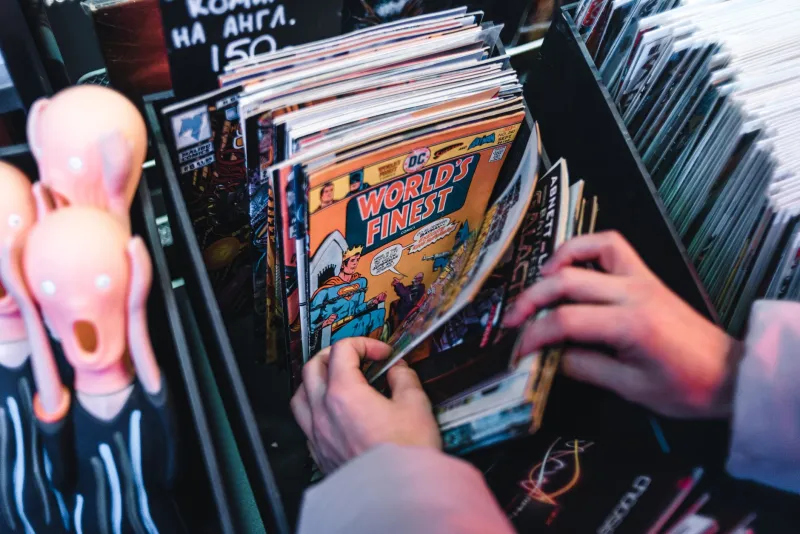
Independent comic shops and bookshops will often take a handful of copies on sale-or-return. Splits are usually somewhere between 60/40 and 70/30 in the shop's favour, and that is fair — they are providing the shelf, the till and the footfall.
What makes consignment work is boring administration. Keep a stock sheet with the date, the quantity, the cover price and the agreed split. Check in every quarter with a friendly message rather than a demand. Accept that some copies will come back with bent corners and a thumbprint on the cover, because that is what a shop copy is. And be realistic: a shop that sells four copies a year is not a bad relationship, it is just a slow one.
The library question
Zine libraries and comics-friendly public libraries occupy a strange, generous space in this ecology. A donation is not a sale, and it should not be dressed up as one. But a copy that sits on a shelf in a zine collection, gets read by someone who would never have found your table, and comes back to you as an email six months later is worth more than the £6 it would have made at a con.
A few practical notes. Ring or email first — do not post boxes at people. Ask whether they want a specific number. Some libraries welcome a stack of ten for a reading group; others want one archival copy and will thank you sincerely. School and college libraries are often the most enthusiastic and the least resourced, so a small donation plus a short letter about how the pages were made can go a long way.
Swaps: the economy that does not use money
The zine table swap is one of the best inventions in small-press culture. You trade three of yours for two of theirs, both parties go home with something new, and nobody has to pretend that a £4 transaction is a business model.
Swaps do something else too. They turn dead stock into research. You end up with a shelf of other people's paper choices, binding tricks and layout decisions, and you start noticing what works. Several makers we have spoken to describe their swap pile as the most useful reference library they own.
There is an etiquette to it, and it is mostly about not being weird. Ask before you take. Do not assume someone wants a straight one-for-one when their book is a 60-page perfect-bound hardback and yours is a 12-page photocopy. And if you are at a table with a 'take one, leave one' basket, actually leave one.
Repurposing without pretending it is a strategy
Creative reuse is the most common answer to the box, and the least discussed. Some of it is genuinely good:
Seconds sales. Any copy with a scuff, a misprint or a slightly wonky trim can be sold cheaply at the end of a table with a handwritten sign. Buyers love a bargain and it clears volume fast.
Bundles. Three issues for the price of two and a half is not sophisticated retail, but it moves stock and makes a stranger try the whole series.
Workshop material. If you teach, a stack of imperfect copies is genuinely useful — for collage, for annotation exercises, for showing a class how a printed page behaves compared to a screen.
Bonus pages. Pull the good spreads out as free inserts with online orders, or as a preview pamphlet for the next issue.
What does not work is pretending a box is an asset. Unloved stock takes up floor space, gathers dust and, in a small flat, quietly becomes a source of low-grade guilt. At some point the kindest thing you can do for your own practice is to give a box away, recycle the ruined copies, and let the shelf breathe again.
Planning the next run honestly
If this year's box was too heavy, next year's plan can be lighter without being smaller in ambition. Try three changes: print a short first run and a reprint later if demand justifies it; price the book to include postage rather than treating postage as a surprise; and write down, before the convention, a realistic sell-through target and a plan for whatever is left.
The reprint is the cheapest mistake to make in self-publishing. Over-printing is the most expensive. Between those two facts sits every decision worth making about paper.