Process, Not Prompt: How UK Manga Artists Are Drawing Their Own AI Lines in 2026
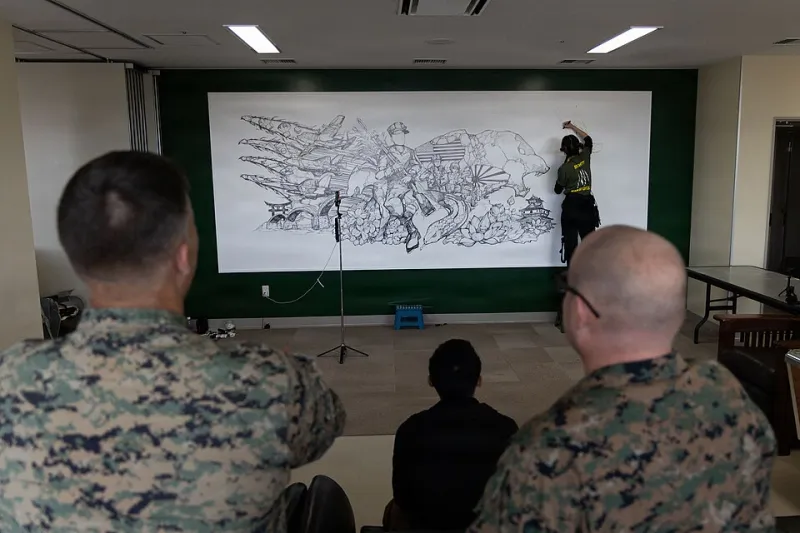
Photo: U.S. Marine Corps photo by Cpl. Cecilia Campbell, Public domain, via Wikimedia Commons
At a zine fair in Sheffield last month, a small handwritten sign did more work than any panel talk. 'No AI-generated work on this table. Ask me why.' The artist behind it, a manga-style illustrator who trades as Bee Okafor, had expected a few awkward questions. Instead she got conversations: about brushes, about layer masks, about why her linework wobbles in the same place every time. 'The sign was not a weapon,' she says. 'It was a door.'
That is the mood across the UK manga art scene in 2026. The AI argument has moved from timelines into tables, submissions forms and printed policies. Artists are not waiting for a universal rulebook. They are writing their own — sometimes on card, sometimes in a zine colophon, sometimes in the small print of a commission sheet. And they are doing it in a way that feels less like a tech war and more like community maintenance.
The sign on the table
Walk through a UK artist alley this year and you will see variations. 'Human-made only.' 'No image generators used in this work.' 'AI-free alley' badges at smaller cons. At the Northline Zine Fair in Sheffield, co-organiser Sasha Kaur says the policy started simple: submissions must disclose if AI was used in any part of the work, and covers must be human-made. 'We are not policing people's private sketchbooks,' she says. 'We are saying what is for sale at a table that calls itself an artist alley. Buyers deserve to know what they are buying.'
The wording matters. A flat ban can feel hostile to artists who use AI for reference sorting or admin, while a total free-for-all can leave buyers confused. Many organisers now separate process from product: use whatever tools you like to plan, but the thing on the table should be yours to explain. That distinction has become a practical compromise in rooms where no one agrees on everything.
Watermarks, timestamps and the paper trail
For illustrators, the response has been less about argument and more about evidence. Bee watermarks her preview images, posts close-up process shots and keeps a folder of layer exports for commissions. 'I do not do it because I think every fan is accusing me,' she says. 'I do it because the internet is a copy-paste machine. A watermark is a seatbelt, not an insult.'
Other artists are leaning into the physical. Riso zines, hand-lettered price cards and ink-stained sketchbooks are their own kind of receipt. At a Bristol comic market, illustrator Tom Rees sells a small 'process pack' with each original: a photocopy of the rough, a note on paper and ink, and a photo of the desk mid-mess. It costs him almost nothing. It also answers the question before it is asked. 'People relax when they can see the joinery,' he says.
The awkward fan conversation
Not every exchange is comfortable. Artists report the same three questions: 'Did you use AI?', 'How do I know?' and 'Why do you hate new tools?' The last one is the hardest, because most artists do not hate new tools. They hate being flattened into a prompt. Hana Patel, a Bristol illustrator, has a script she uses at tables. 'I say: I do not use image generators for my work, and here is how I built this page — pencil, ink, flat colour, texture. If you want to talk about tools, great. If you want to argue, I have to sell prints.'
That boundary is important. Artist alleys are workspaces, not debate stages. Several organisers now brief volunteers to step in if a conversation turns into a harassment session. The rule is simple: ask once, accept the answer, buy or move on. Fans who want a longer discussion can go to a panel, a zine, or an artist's FAQ. The table is for transactions and quick hellos.
Alleys writing their own rules
The most interesting policies are local. Manga Market North, a Manchester-based event, introduced an 'AI disclosure' tick box on its artist application in 2026. It does not ban AI-assisted work outright; it asks artists to describe how it was used and requires them to label any AI-generated elements on the table. 'We wanted honesty, not a witch hunt,' says organiser Priya Desai. 'If someone uses AI for a background texture and says so, buyers can decide. If someone says hand-drawn and it is not, that is a trust problem.'
Smaller zine fairs have gone further, with AI-free tables and submission checks. The result is a patchwork, which can be annoying for artists who travel the circuit. But it also means each community can set its own temperature. A family-friendly comic fair may want stricter rules than a late-night art market. A charity zine may welcome AI-assisted layouts if the drawing is human. There is no single UK manga AI policy, and that might be the healthiest thing about it.
What good policy looks like
For artists, organisers and fans, the practical checklist is short:
- Put your policy where people can see it: table sign, application form, zine colophon.
- Be specific. 'No AI' is clear; 'AI-free except for admin' is clearer.
- Disclose early. A line in a commission sheet beats an argument at the table.
- Watermark previews, keep process files, and do not assume every question is an attack.
- Do not interrogate artists in front of a queue. Ask once, politely.
- Buy the work you believe in. That is still the strongest vote.
The AI debate will keep changing. Models update, laws shift, platforms rename themselves. But the UK manga art scene is already doing what it does best: making rules in public, with a marker pen and a bit of patience. The sign on Bee's table has been rewritten three times this year. It still ends with the same invitation: ask me why. In 2026, that feels less like a challenge and more like a way to keep the alley human.