The Huff, the Folded Arms and the Half-Step Forward: Drawing a Very British Queue
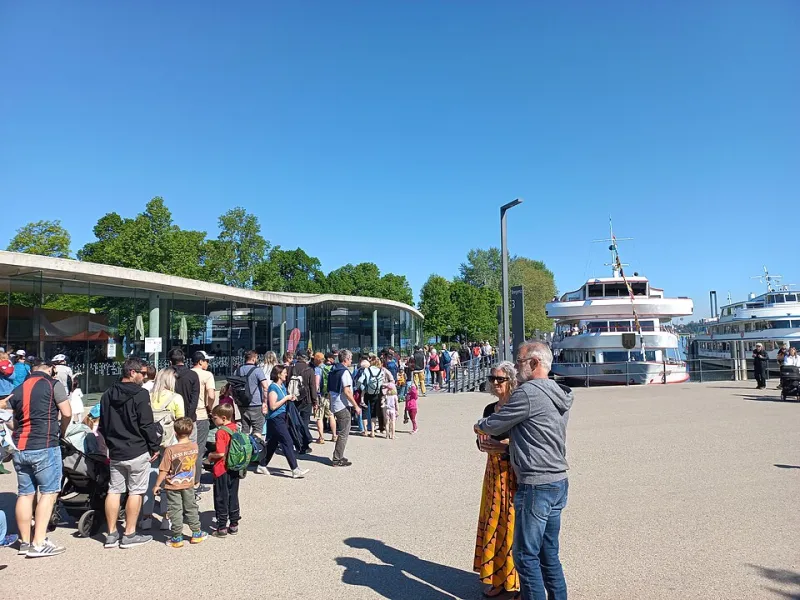
Photo: Asurnipal, CC BY-SA 4.0, via Wikimedia Commons
Ask a room of manga artists what they find hardest to draw and you'll get the usual answers: hands, perspective, horses. Ask them what they find hardest to draw honestly and the answer is quieter. It's waiting.
Action is easy. Action has a shape. A punch is a fist, an arc, a reaction. But a queue is a hundred small negotiations happening at ankle height, and getting it right on the page is one of the most interesting problems in British-made manga right now.
Waiting is the drama
Manga has always understood that tension lives in the gap between events. The panel before the swing. The silent page. An entire chapter where two characters sit in a room and nothing is said.
British life is absolutely stuffed with that energy, and most of it happens in a queue. There is more character reveal in six people standing outside a chip shop at half nine on a Friday than there is in most fight scenes. Who stands with their arms folded. Who leans on the wall. Who keeps looking at their phone and then putting it away. Who has clearly joined the wrong queue and is now too polite to leave it.
That last one is, by common agreement among the artists who draw this stuff, the most British panel in existence.
Anatomy of a queue in five panels
There's a rough grammar to it, and once you notice it you can't unsee it.
Panel one: the line itself. Wide, horizontal, low camera angle. The queue reads as a single object — a snake with a head. This is where you establish scale and patience.
Panel two: the head of the queue. Close on the counter. Someone is being served and taking longer than anyone expected. This is the inciting incident.
Panel three: the reaction. Repeat an almost identical panel of the same three figures. Nothing changes. The repetition is the joke, and it's also the passage of time. Two identical panels in a row can communicate five minutes without a single caption.
Panel four: the huff. One character exhales. Arms fold. Weight shifts onto the other leg. In manga terms this is your big emotional beat, and it lands because everything around it is still.
Panel five: the half-step. The queue inches forward by eighteen inches. Everyone moves at once and then stops. Nobody speaks.
Five panels, no dialogue, and the reader knows exactly how long they've been there.
"Nobody moves and everything happens"
Priya, a Bristol-based artist who has been drawing queue scenes for three years, puts it simply: the queue is a pressure cooker with the lid bolted on.
"In a fight scene the emotion is allowed out," she says. "In a queue it's all held. That's much more interesting to draw, because you're drawing restraint. You're drawing someone choosing not to say something."
Her favourite subject is the folded-arms huff, which she describes as the closest thing Britain has to a shout. "The arms go, the eyebrows go, the mouth stays exactly the same. That's the panel. The face doesn't change but the whole body is furious."
Callum, who draws a self-published series set entirely in a Scottish bus station, has a different obsession: the negotiation.
"There's a whole conversation that happens without words when someone joins a queue and isn't sure it's the right one," he says. "They hover about a metre off the back. Then they lean round to look at the front. Then someone else joins behind them and that settles it — they're committed now. Four panels, no speech, complete story."
Why the huff is easier to draw than a punch
Counter-intuitively, a lot of artists find queue scenes more forgiving than action. A badly drawn fight is instantly obvious. A badly drawn queue is just... people standing about, and the reader fills in the rest.
The difficulty is subtler. It's rhythm. You have to decide how long the reader is made to wait, and you have to make waiting feel deliberate rather than lazy.
The tools are mostly the same ones used for pacing a chase:
- Panel width controls tempo. Long thin panels slow the eye down; short stacked panels speed it up.
- Repeated framing communicates duration better than any clock.
- Silence. No speech bubbles, no sound effects, no captions. Let the emptiness do the work.
- One small change per panel. A thumb in a pocket. A bag moved from one hand to the other. That's enough.
Where British artists differ from the manga they grew up reading is in the volume. Queue scenes here tend to be quieter — fewer sweat drops, fewer exclamation marks. The huff doesn't need a sound effect. It needs a beat of nothing, then the shoulders dropping by two millimetres.
The line as a portrait of a place
There's a reason this keeps showing up in UK-made manga. A queue is civic. It's a small agreement between strangers that the world will be fair for the next ten minutes. It's also where class, weather, patience and the national reluctance to make a scene all meet in one composition.
Draw a bus queue in a Scottish town in February and you're drawing a country. Not through symbolism — through posture. The hood up. The hands in sleeves. The one person who has given up and sat on the wall.
So the next time you're stuck in a line and someone behind you does the sigh, look properly. Note where their weight goes. Note who looks at the front and who looks at the ground. That's a panel. It's been sitting there waiting for you the whole time.